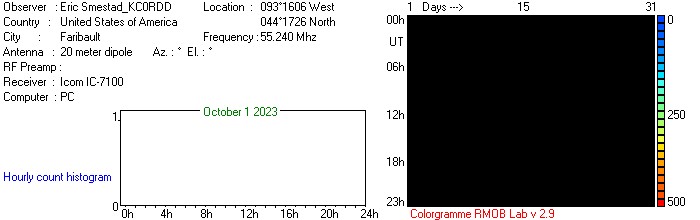
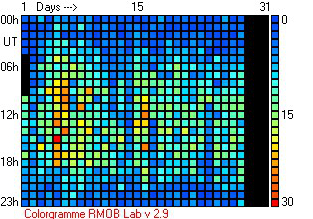
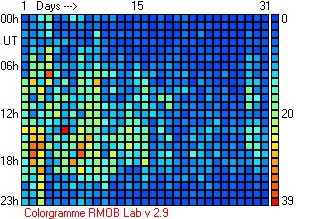
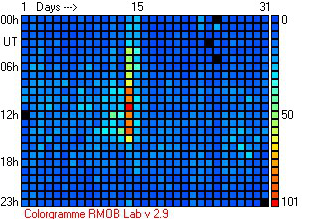
System taken off-line for moving 10/1/2023. Unknown if/when system will be brought back up
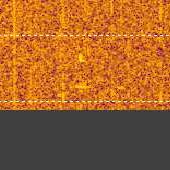
2015-02 2015-01 2014-12 Note the geminid meteor shower (peak 12/14/2014) Last strong echo
Listen (in testing phase) LastStrongEcho.wav
Frequency (audio Hz from receiver) by time
Frequency by time summary
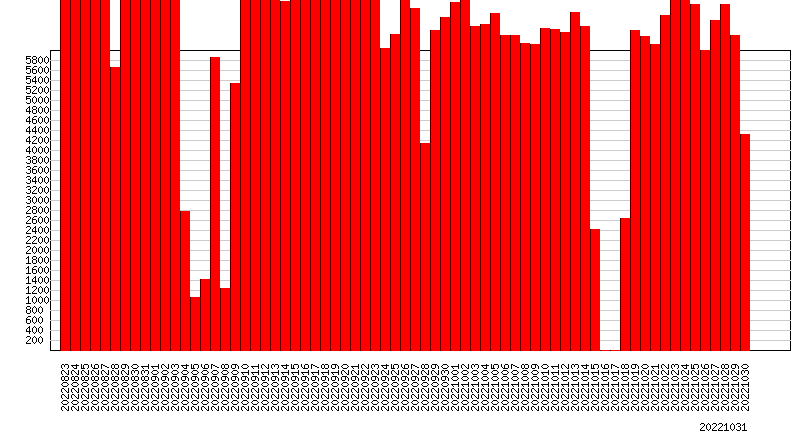
Daily totals
About Radio Meteor Detection
Radio meteor detection can be done by tuning in a video signal of a VHF TV
station which you
normally do not get a signal on and is within a couple hundred miles. The
reason this works is when meteors enter the earth's atmosphere the heat and
the pressure ionizes the air. The ionized air works as a radio mirror for a
short
time. The radio signal of the TV station bounces off of the ionized trail and
you can hear the station for a very short duration.
These charts were made by monitoring the pilot frequency of a TV
station using CW mode. The audio output is ran to the sound input of a
computer and the sound is analyzed and detections are logged using
Spectrum Laboratory https://www.qsl.net/dl4yhf/spectra1.html
Detecting meteors after the digital TV transition
Digital television transmitions contain a carrier frequency that is suitable
for detecting meteors. With my original station I was detecting meteors using the ATSC
pilot frequency of digital TV station channel 6 (82.31 Mhz). I had to tune
down a little to 82.3094 Mhz but your exact tuning may vary. With the radio
turned to 82.3094 Mhz in CW mode I get an audio signal of about 850 Hz when a meteor
is detected.
What a typical detection sounds like
Below is a link to an audio file (wav) containing what a typical detection
sounds like along with some background noise. Best to right click and
choose "save as" and then play in your preferred audio player. Typical detection
ATSC pilot frequencies
Channel
Pilot Frequency (Mhz)
2
54.31
3
60.31
4
66.31
5
76.31
6
82.31
7
174.31
8
180.31
9
186.31
10
192.31
11
198.31
12
204.31
13
210.31
14
470.31
15
476.31
16
482.31
17
488.31
18
494.31
19
500.31
20
506.31
21
512.31
22
518.31
23
524.31
24
530.31
25
536.31
26
542.31
27
548.31
28
554.31
29
560.31
30
566.31
31
572.31
32
578.31
33
584.31
34
590.31
35
596.31
36
602.31
37
608.31
38
614.31
39
620.31
40
626.31
41
632.31
42
638.31
43
644.31
44
650.31
45
656.31
46
662.31
47
668.31
48
674.31
49
680.31
50
686.31
51
692.31
52
698.31
53
704.31
54
710.31
55
716.31
56
722.31
57
728.31
58
734.31
59
740.31
60
746.31
61
752.31
62
758.31
63
764.31
64
770.31
65
776.31
66
782.31
67
788.31
68
794.31
69
800.31
70
806.31
71
812.31
72
818.31
73
824.31
74
830.31
75
836.31
76
842.31
77
848.31
78
854.31
79
860.31
80
866.31
81
872.31
82
878.31
83
884.31
Meteor Rates and Why Meteor Showers Happen Regularly
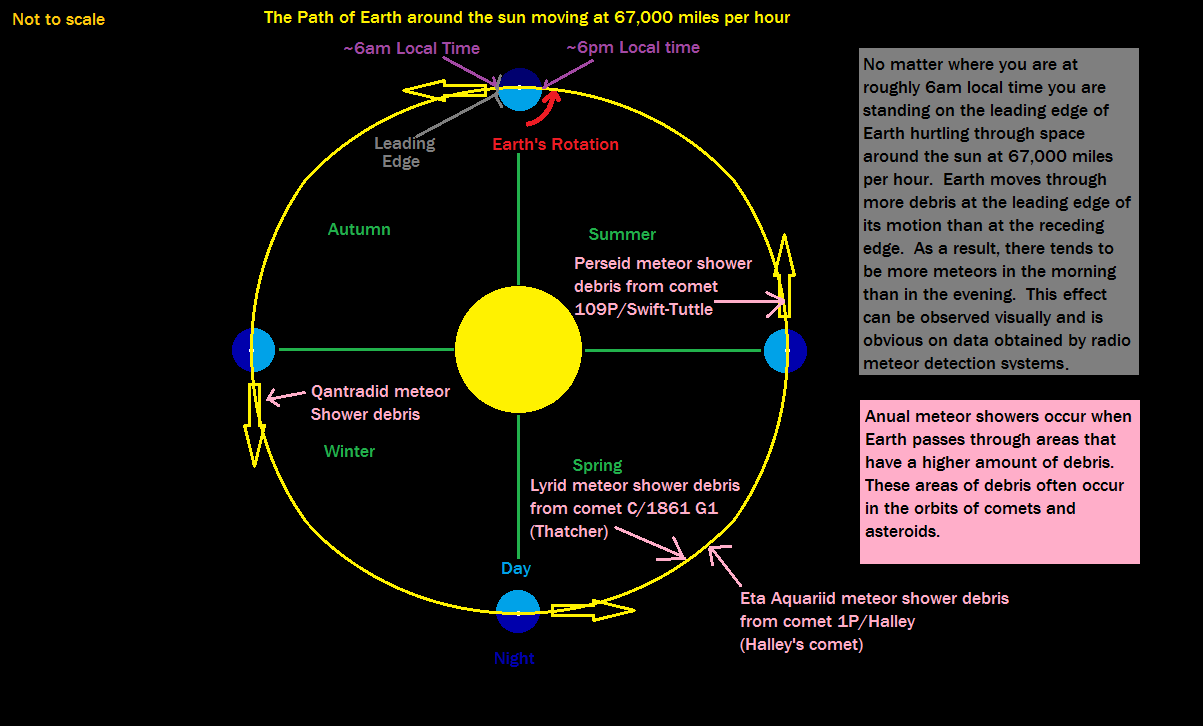
The reason we experience meteor showers is that as the earth orbits around the sun it passes through areas that are more
dense with debris. These areas are often near the orbits of comets and asteroids. For example,
each spring during the Eta Aquarid meteor shower Earth passes an area with
debris from Halley's comet.
The peak time for meteors at a given location tends to be around 6am local time
no matter where you are. This is due to the fact that you are standing on
the leading edge of Earth's rotation as the below illustration shows.
Log 2023-10-01 System taken off-line for moving. Unknown if/when system will be brought back up 2023-09-01 Switching from 55.240.28 Mhz to ~54.31 Mhz as a quick test, prior frequency is so strong that regularly I get solid carrier affecting counts. Switched back, not much different just weaker on 54.31 2022-03-23 Antenna or cable issue. Station is down for now. 2019-09-30 Strong QRM has been preventing reception across most
radio bands again over the last few days severely impacting performance of
the radio meteor detection system 2019-08-13 Strong QRM was preventing reception across most bands.
Possibly related to nearby electrical line work being done 2019-07-24 Station is back up and working. There were 2 problems.
A cable end had corroded and was no longer making a connection. Upon fixing
that I was still getting very weak signals. Ultimately it turned out that
the pre-amp I was using had also failed. 2019-07-23
The station remains down due to an antenna/cable issue. Hopefully it will
be back up soon. 2019-07-22
There was a bad connection. Re-did BNC connector on main
antenna cable. Still testing 2019-07-21 System is not working. Possible antenna problem.
Possibly another cause 2019-07-20 Temporary radio propagation conditions have affected
the ability to detect meteors intermittently lately. 2019-07-09 Changed back to Kenwood TS-2000 on 54.3094 Mhz, the
TH-F6 was experiencing frequency drift 2019-07-08 Changed radio to Kenwood TH-F6 on 54.3097 Mhz as a
test at 3pm CDT (note: was getting solid signal at the time, need radio
conditions to improve to fully test) 2019-01-29 Re-tuned to 54.3094 2018-10-04 Re-tuned to 54.30945 (testing) 2018-10-03 Re-tuned to 54.3096 (was 54.3095) 2018-09-05 Re-tuned to 54.3095 (was 54.30954) 2018-09-03 Changed to new station on 54.30954 Mhz using Kenwood TS-2000 on quadrifilar helix antenna 2018-09-01 Changed threshold to 16 (was 17) 2018-08-31 Changed threshold to 17 (was 18) 2018-08-30 Changed range to 820-1050hz (was 870-1100hz) 2018-08-29 Re-tuned to 82.3096 Mhz (was 82.3095 Mhz) 2018-08-26 Changed range to 870-1100hz (was 770-1000hz) 2017-01-13 Re-tunred to 82.3095 Mhz 2016-09-04 Changed beginning of frequency range for trigger
actions to 860 (was 600) to avoid auroral propagation from setting it off 2015-11-21 Re-tunred to 82.3095 Mhz as a test, then tuned back to
82.3094 Mhz 2015-03-17 Auroral propagation caused some false detections. There was a severe geomagnetic
storm where the KP index reached 8 during the peak. It was the strongest geomagnetic
storm of this solar cycle so far. Chart. 2015-02-01 Removed data for 5 hours. Possible sporadic-E 2015-01-07 Now running on a different computer 2014-12-26 Now running with RMOB conversion routine and submitting
results to the radio meteor observers page http://www.rmob.org/livedata/main.php
2014-12-13 Re-tuned receiver to 82.3094 Mhz
2014-11-13 Some people may say I have the %#!@ touch with sound cards.
It may be true. Yesterday the input went bad on the sound card I was
using for the meteor logger. It is now running again now on a turtle beach
USB sound card (an Amigo II) that I had on hand. Turtle beach to the rescue. If you have the %#!@ touch with
sound cards like I do, you may want to keep a couple of these on hand. ;)
2014-10-21
As Murphy's law would indicate, on 2014-10-21 (Peak of Orionid meteor
shower) the computer that has been running the meteor logger flawlessly for
over 2 months unexpectedly rebooted while I was sleeping and so I lost a
good chunk of data. (~7am-~11:40am)
Visually I saw 27 meteors at a rate close to 3 times normal meteor rates
from my locaton while the logger while running does not show a significantly
higher rate. It is possible that most of the meteors associated with this shower were
not strong enough to make non specular detections with my current setup.
Various Charts
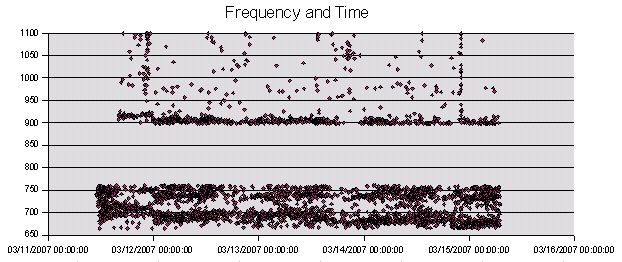
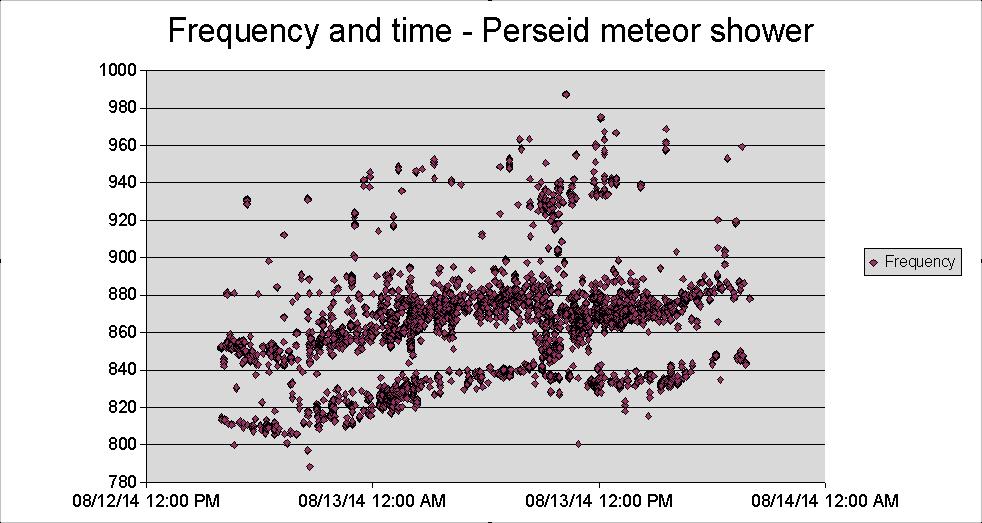
Frequency and Time
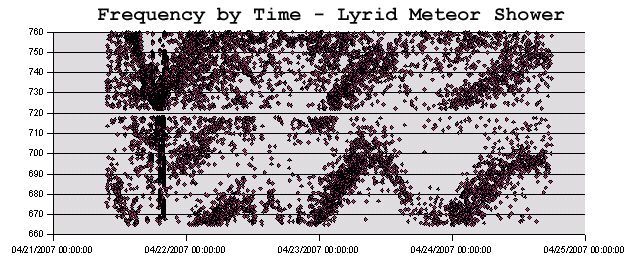
Frequency and Time - Lyrid Meteor Shower
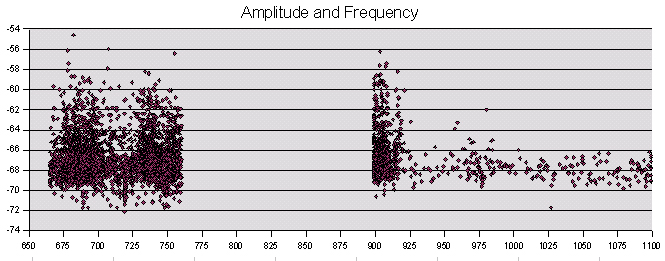
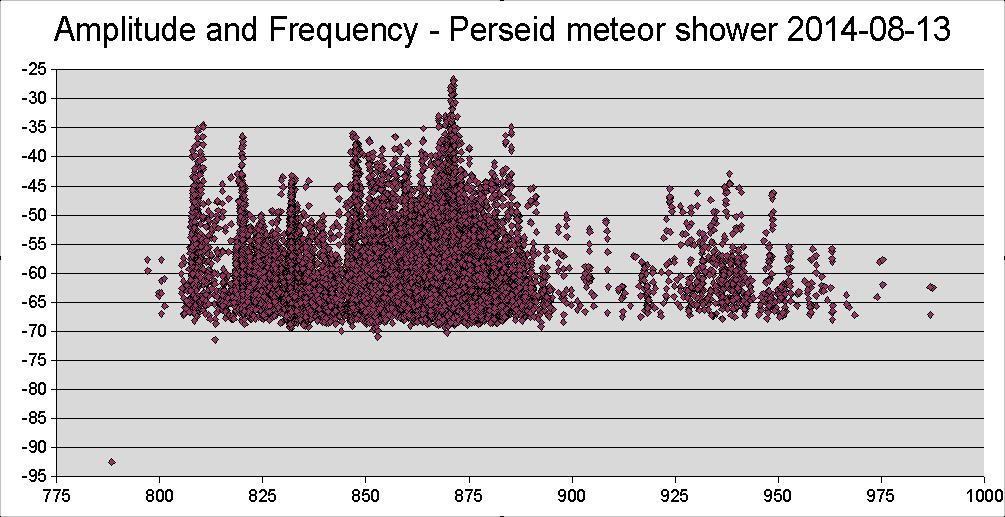
Amplitude and Frequency
Note the gap between 775 and 895 hz, that is part of the airplane filter
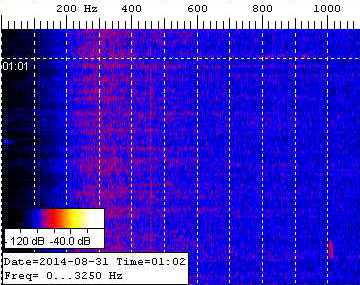
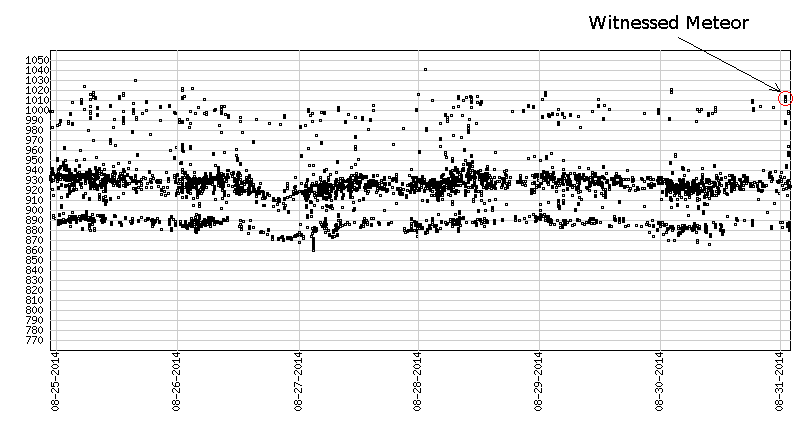
Just after 1 AM on August 31, 2014 a friend and I witnessed a bright meteor
in the West, moving East to West. We checked the meteor logger and the meteor showed on the FFT and the meteor was detected. Part of FFT showing the meteor echo (red line on lower right of image)
Frequency chart showing the meteor detection
Data of actual detection (DateTime, Frequency, Amplitude)